Jul 4, 2026
How Long Should You Practice Indoor Golf Each Day? A Step-by-Step Routine for Steady Improvement
When I first started practicing golf indoors, I honestly thought the longer I practiced, the faster I would improve. I would spend an hour hitting foam balls into a net, repeating the same swing over and over until my hands felt sore. At the end of those sessions, I was exhausted—but surprisingly, I wasn’t getting much better.
Eventually I realized something that experienced golfers had been saying all along: improvement doesn’t come from simply spending more time swinging a club. It comes from practicing with a purpose.
Indoor practice has become a regular part of my golf routine because it’s convenient, weatherproof, and easy to fit into a busy schedule. Even on days when I can’t make it to the driving range or the golf course, I can still improve important parts of my game right at home.
After years of experimenting with different practice schedules, I’ve found that a shorter, structured session almost always produces better results than a long session without a clear goal. If you’re just getting started, you don’t need to practice for hours every day. What matters much more is practicing the right things in the right order.
Consistency beats marathon practice sessions almost every time.
One mistake I made early on was treating indoor practice like a weekend project. I’d skip golf for several days, then suddenly spend two or three hours swinging indoors because I felt guilty.
Those marathon sessions usually left me tired instead of productive.
Golf is a skill built through repetition, but your body also needs time to absorb movement patterns. Practicing for twenty to forty minutes nearly every day creates much stronger muscle memory than one extremely long session each week.
Professional athletes don’t improve because they occasionally train for an entire day. They improve because they repeat quality movements consistently over months and years.
I noticed the biggest improvements in my own swing after I committed to shorter daily sessions instead of chasing long practice days.

Fifteen minutes is enough for complete beginners.
If you’ve never practiced golf indoors before, don’t worry about spending an hour swinging a club.
In fact, I usually recommend the opposite.
For complete beginners, fifteen to twenty minutes is often the ideal starting point. During that time, your concentration stays high, your body doesn’t become overly fatigued, and you’re less likely to reinforce poor mechanics simply because you’re tired.
Early improvement comes from learning correct positions rather than hitting hundreds of golf balls.
When I introduced one of my friends to indoor practice, we limited every session to about twenty minutes for the first two weeks. Instead of feeling overwhelmed, he actually looked forward to practicing because the sessions never felt like a chore.
Intermediate golfers usually benefit from thirty to forty-five minutes.
Once you’ve developed a reasonably repeatable swing, your practice sessions can naturally become a little longer.
For me, somewhere between thirty and forty-five minutes feels like the sweet spot.
That amount of time allows me to warm up properly, work on one or two technical changes, practice impact, hit simulated shots into the net, and finish with putting or short-game drills.
Longer sessions aren’t automatically better.
Whenever I notice my focus fading or my swing becoming sloppy, I simply stop. There’s very little benefit in practicing bad habits for another thirty minutes.
Always begin with mobility before touching a golf club.
This is one habit I wish I had developed much earlier.
Years ago, I would grab my driver, take a couple of quick practice swings, and immediately start hitting balls.
Now I spend five minutes warming up before every session.
A simple warm-up might include shoulder circles, torso rotations, gentle hip turns, bodyweight squats, wrist mobility exercises, and slow practice swings without a ball.
These movements prepare the muscles you’ll actually use during the golf swing.
I also find that my balance feels much better after warming up, especially if I’ve been sitting at my desk most of the day.
Start every practice session by checking your setup.
Before worrying about swing speed or distance, I always take a moment to examine the fundamentals.
That means checking my grip, posture, stance width, ball position, and alignment.
It’s amazing how many swing problems actually begin before the club even starts moving.
I sometimes place an alignment stick or even a spare club on the floor to make sure my feet and shoulders are aimed correctly.
When my setup is consistent, everything that follows tends to become much easier.
Build your swing slowly instead of hitting full-speed shots immediately.
One lesson I’ve learned is that speed often hides mistakes.
If I immediately start making full-power swings, it’s difficult to feel exactly what’s happening during the motion.
Instead, I begin with slow-motion rehearsals.
I might spend five or ten swings moving at only half speed, paying attention to my takeaway, shoulder turn, weight transfer, and finish position.
Those slow repetitions help my body remember the correct movement before I gradually increase speed.
Ironically, slowing down often leads to better full-speed swings later in the session.
Practice one specific skill instead of trying to fix everything at once.
This has probably been the biggest improvement in my practice routine.
Earlier in my golf journey, every session had ten different goals. I’d work on my grip for a few swings, then my backswing, then tempo, then clubface control, then putting, then chipping—all within thirty minutes.
The result was predictable.
I improved almost nothing.
Now I choose one priority before I even begin practicing.
Maybe today’s focus is maintaining posture through impact. Tomorrow might be improving tempo. The following day could be centered entirely around face control or ball striking.
Giving my brain one clear objective makes every repetition much more meaningful.
Adding short-game practice indoors pays off more than most golfers expect.
When I first bought an indoor putting mat, I honestly thought it would just be something fun to use on rainy days. I didn’t expect it to have much impact on my scores.
I couldn’t have been more wrong.
After a few weeks of spending ten to fifteen minutes putting almost every evening, I noticed something interesting when I returned to the golf course. I wasn’t making every putt, but I felt much more comfortable standing over the ball. My pace improved, my setup became more consistent, and those nervous three-foot putts suddenly didn’t seem quite as intimidating.
If you only have a small indoor space, don’t underestimate what putting practice can do. Since nearly half of the strokes during a typical round happen on or around the green, becoming more confident with your putter can lower scores faster than simply trying to hit the ball farther.
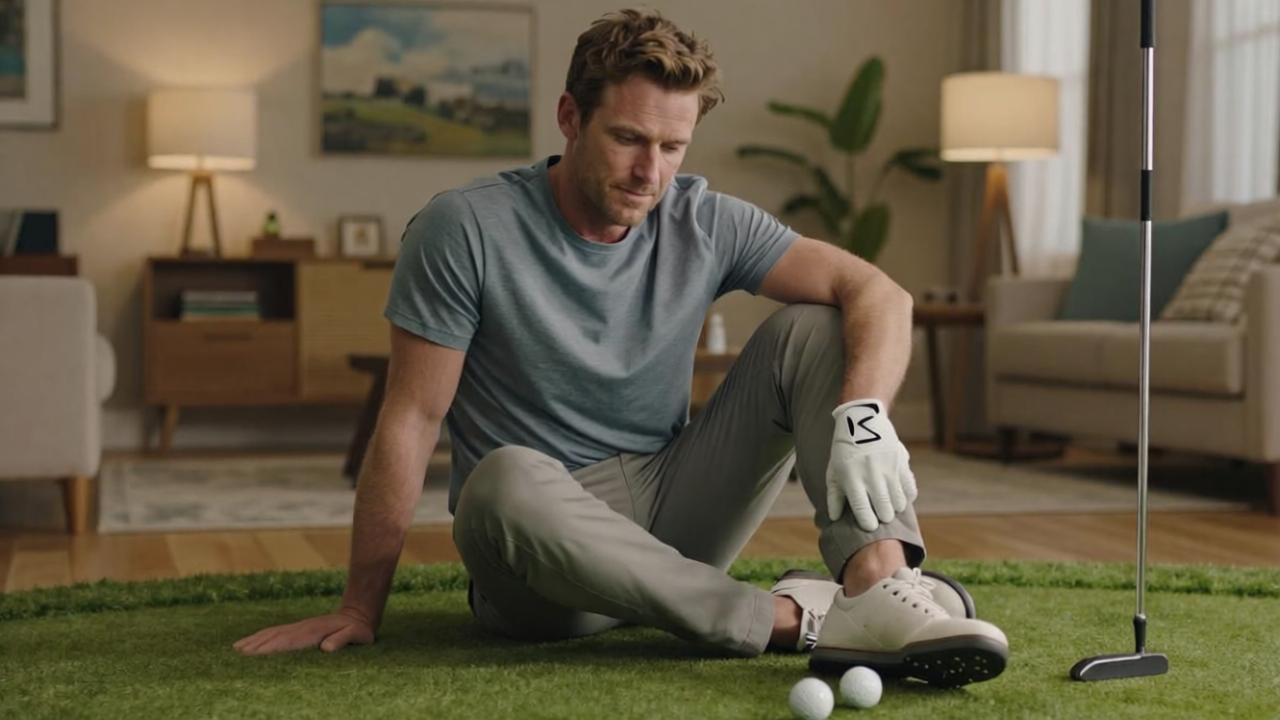
Recording your swing helps you notice mistakes you never feel.
One habit that completely changed my indoor practice routine was recording my swing with my phone.
At first, it felt a little awkward watching myself swing. I thought I already knew what I was doing.
Then I compared what I felt with what the video actually showed.
The difference surprised me.
I believed my backswing was short, but it was actually much longer than I imagined. I thought my posture stayed stable, yet I could clearly see myself standing up through impact.
That experience taught me an important lesson: feel and reality are often very different in golf.
You don’t need expensive launch monitors or professional cameras. A smartphone placed safely behind or beside your hitting area can provide valuable feedback. Watching only two or three swings after each practice block is often enough to identify patterns without becoming overly critical of every movement.
Increase practice time gradually as your technique becomes more consistent.
Many golfers ask whether they should eventually practice for an hour or more every day.
My answer is usually, “Only if you can maintain quality.”
Once your body becomes comfortable with regular practice, extending your sessions little by little makes sense. Instead of jumping from twenty minutes to ninety minutes overnight, add five or ten minutes every couple of weeks.
I found that my concentration naturally started lasting longer as my practice habits improved. Thirty minutes eventually became forty, and forty occasionally became an hour when I wanted to work on several parts of my game.
The key is making sure those extra minutes remain productive. The moment I notice my tempo falling apart or my attention drifting, I know it’s time to stop for the day.
A simple weekly routine is easier to maintain than an overly complicated schedule.
One mistake I see many golfers make is designing an ambitious practice plan that looks great on paper but is impossible to follow consistently.
I prefer something much simpler.
For example, one week might look like this:
Monday: Grip, setup, posture, and alignment.
Tuesday: Half-speed swing drills and impact position.
Wednesday: Putting practice and distance control.
Thursday: Tempo and rhythm drills with irons.
Friday: Ball striking into the practice net.
Saturday: Combine all the fundamentals into a full practice session.
Sunday: Light stretching, putting, or complete rest.
Having a flexible structure keeps me focused without making golf feel like another job. If life gets busy and I miss a day, I simply continue with the next session instead of trying to squeeze two workouts into one evening.
Tracking small improvements keeps motivation much higher.
Golf improvement can feel frustrating because progress usually happens gradually.
Instead of measuring success by how far I hit the ball, I started paying attention to much smaller victories.
Maybe today I finished every swing in balance. Maybe my alignment stayed consistent for an entire practice session. Maybe I made twenty straight putts from four feet.
Those small accomplishments build confidence over time.
I even keep a simple notebook where I write down one thing that improved and one thing I want to work on next time. Looking back after several months reminds me just how much progress steady practice can produce.
Patience is one of the most valuable golf skills you’ll ever develop.
Indoor practice has taught me that becoming a better golfer isn’t about chasing perfect swings every single day. Some sessions feel fantastic, while others leave me wondering if I’ve forgotten everything I know. That’s simply part of learning a game as challenging as golf.
What has made the biggest difference for me is showing up consistently, following a simple routine, and trusting that small improvements eventually add up. Even twenty or thirty focused minutes at home can strengthen fundamentals that carry over to the course. Looking back, I’m glad I stopped measuring practice by the clock and started measuring it by the quality of each repetition. That’s when indoor practice became something I genuinely enjoyed instead of something I felt obligated to do, and it’s still the routine I rely on whenever I want my swing to stay sharp throughout the year.
More Details